Home
About Work Packages Partners Deliverables
Living Labs
Materials Practice Abstracts Newsletter
News Contact
Facebook LinkedIn
Project

Work Packages

Nine work packages translate the SAVE water objectives into action, from project management and stakeholder engagement to the water system database, real-time monitoring, modelling, the decision-support dashboard and dissemination.

WP1 Project management coordination

WP1 — Project management coordination

Faculty of Sciences of Tunis, University of Tunis El Manar (FST-UTM)

  • To implement project infrastructure for efficient reporting and internal communication.
  • To administer and transfer payments between the partners and the funding authority.
  • To consolidate and submit periodic progress reports and the final report, including financial reports (Project Management Plan, midterm management report and final project report).
  • To address all financial, ethical, legal, intellectual property and administrative matters related to the consortium, and to manage gender equality in line with PRIMA procedures.
WP2 Stakeholder engagement plan

WP2 — Stakeholder engagement plan

Faculty of Sciences of Tunis, University of Tunis El Manar (FST-UTM)

  • To establish Living Labs in water-scarce areas across the Mediterranean and European region and to organise all Living Lab activities.
  • To build the Water Living Labs Network to foster synergies between the SAVE water project and other infrastructures, networks and projects.
  • To gather stakeholder data-sets and report on workshops and meetings, supporting the rest of the work packages through a participatory approach (Living Lab events report, ethics report and gender action plan).
WP3 Diagnosing Mediterranean water management systems

WP3 – Diagnosing Mediterranean water management systems

University of Badji Mokhtar Annaba (UBMA)

  • To map current water projects, initiatives, databases and infrastructures in order to gather water data, and to assess water availability, quality and ecosystem interactions in rural and urban areas (Data Collection and Analysis / water demand report).
  • To evaluate policy and governance frameworks for water management (Policy and Governance Evaluation report).
  • To review water monitoring research studies and their limitations, and to assess environmental impacts and climate change considerations.
WP4 Establishing a water system database

WP4 — Establishing a water system database

Institute of Applied Sciences and Intelligent Systems — CNR (ISASI-CNR)

  • To design and develop the SAVE water database (W-DB) that harmonises external and project water data (database design document).
  • To build a comprehensive collection of cleaned and standardised data sets, including Living Lab data adapted for the Mediterranean area.
  • To deploy a fully developed, functional and operational database accessible to the whole consortium.
WP5 Developing real-time monitoring water systems based on artificial intelligence and machine learning

WP5 — Developing real-time monitoring water systems based on artificial intelligence and machine learning

Manouba School of Engineering (MSE-UMA)

  • To develop intelligent, real-time water monitoring systems driven by artificial intelligence and machine learning.
  • To develop water sensors adapted to the monitored systems (water sensors development).
  • To deliver the water sensors processing report consolidating data processing and analysis.
WP6 Remote sensing and artificial intelligence-based models to evaluate the impact of vegetation on hydrological systems

WP6 — Remote sensing and artificial intelligence-based models to evaluate the impact of vegetation on hydrological systems

CIRAD — French Agricultural Research Centre for International Development

  • To develop SVAT (Soil-Vegetation-Atmosphere Transfer) and AI models coupling vegetation and hydrological processes.
  • To deliver a methodology to upscale vegetation metrics using remote sensing and AI.
  • To model the impact of land use and climate changes on hydrological systems, providing a framework for new model development.
WP7 Development of a multicriteria model based on GIS for vulnerability to pollution and socio-economic impacts

WP7 — Development of a multicriteria model based on GIS for vulnerability to pollution and socio-economic impacts

Faculty of Sciences of Tunis, University of Tunis El Manar (FST-UTM)

  • To develop an integrated assessment framework for transparently evaluating water management and land-use scenarios on water sustainability and ecosystem services (multicriteria analysis report).
  • To establish a locally adapted GIS-based water vulnerability model for the prevention and protection of highly at-risk water systems.
  • To propose sustainable insurance programmes and a policies and strategies toolbox to support water managers.
WP8 Development of a dashboard for sustainable water management

WP8 — Development of a dashboard for sustainable water management

Faculty of Agriculture, Fayoum University (FOAFU)

  • To design mockups and prototypes of the decision-support dashboard presenting the aggregated knowledge in an easy-to-access format.
  • To develop the data integration framework and a beta version of the dashboard.
  • To collect user feedback and deliver the final dashboard and deployment report, supporting collaborative decision-making.
WP9 Dissemination, training, and technology transfer

WP9 – Dissemination, training, and technology transfer

Faculty of Sciences of Tunis, University of Tunis El Manar (FST-UTM)

  • To build and maintain the SAVE water website and collaborative platform.
  • To prepare the Communication and Dissemination plan and facilitate active dissemination and demonstration of sustainable water management practices.
  • To report on the dissemination of project results and to design a project exploitation and sustainability strategy, including training and technology transfer.

Project Timeline

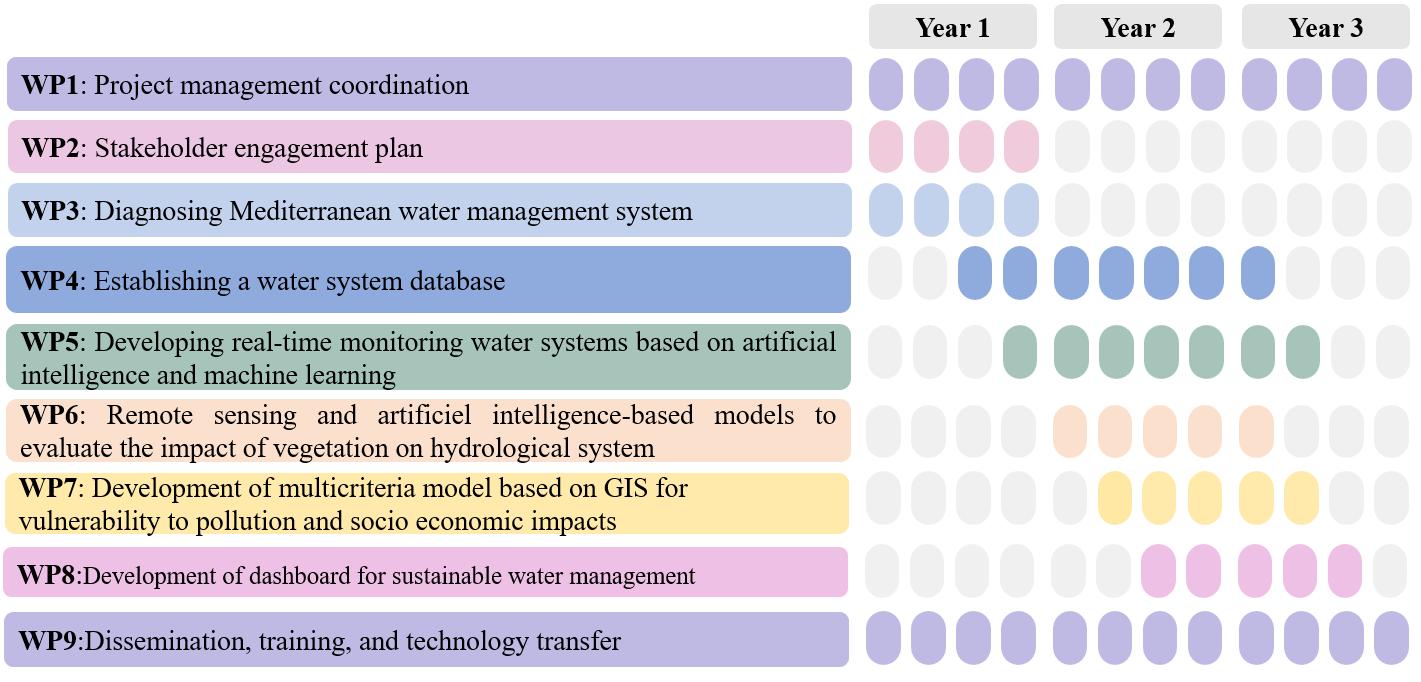
The Gantt chart below shows the SAVE water work packages and their expected duration over the 36-month project period.

SAVE water work packages Gantt chart showing the timeline of WP1 to WP9 over 36 months
Figure 3.1a — SAVE water work packages Gantt chart